
Security Tips and Accessibility - Quizzes
On This Page
Respondus Lockdown Browser Accessibility Tips
Use Respondus Lockdown Browser
Accessibility Concerns about Restricting IP Addresses
Add Password Protection
Step 1
Select Quizzes in the navbar.
Step 2
Select the quiz name.
Step 3
Select the Availability Dates & Conditions section.
Step 4
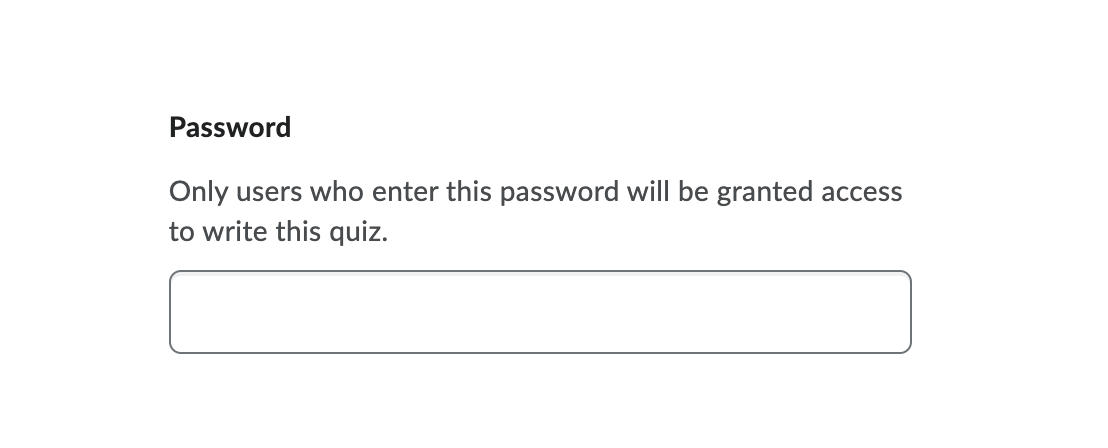
Type in the Password you want to use.
Note
Passwords must contain between 1 and 20 characters and can include letters, numbers, and special characters. Passwords are case-sensitive.
Step 5
Select the Save button to remain in the quiz (or Save and Close to save your changes and exit the quiz).
Respondus LockDown Browser Accessibility Tips
Respondus LockDown Browser is a third-party integration that provides ways to limit students’ activity on their device while taking a quiz.
In most cases, Respondus LockDown Browser will work with assistive technology, like text-to-speech software; however, it can be inconsistent and cause technological frustrations for students. Because of these inconsistencies, learners who are blind or have low vision may not be able to take a quiz that uses LockDown Browser.
According to best practices of Universal Design for Learning (opens in new tab), it is actually best to avoid using LockDown Browser. If you opt to use it, we suggest the following strategy to support all users:
Accessible Strategy
If you use Lockdown Browser, you can create a second version of the quiz (one that does not require LockDown Browser) by copying the original and using Brightspace's special access function to make it available only to learners with low vision, who are blind, or others for whom Lockdown Browser will negatively affect their experience.
Note
You will need to manually enter grades for this second version or set up an exemption in Grades. Contact the Instructional Technology team if you would like to discuss these or other options for managing your gradebook.
Use Respondus Lockdown Browser
Important
- Instructors must take the Brightspace Respondus LockDown Browser training course in Discover before the Brightspace Consulting Team activates LockDown Browser in your course. Lockdown browser does not work with Chromebooks, iPhones, Linux, or XBox.
- Students can still use their phones to look up answers and take pictures of the quiz. They can also install applications that still allow them to record their screens. Therefore the LockDown browser works best in a proctored setting and when students use a lab computer.
- Students using iPads must download and install the LockDown Browser app.
Note
We recommend using the LockDown Browser first on a low-stakes quiz to ensure everyone is comfortable before taking a high-stakes exam.
Step 1
Select Quizzes in the course navbar.
Step 2
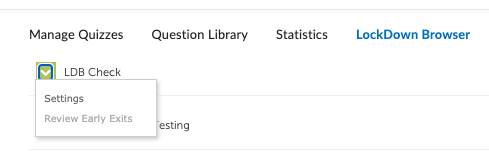
Select the LockDown Browser tab.
Step 3
Select the quiz’s Action Menu icon in the LockDown Browser screen and select Settings.
Step 4
Select Require Respondus LockDown Browser for this exam.
Step 5
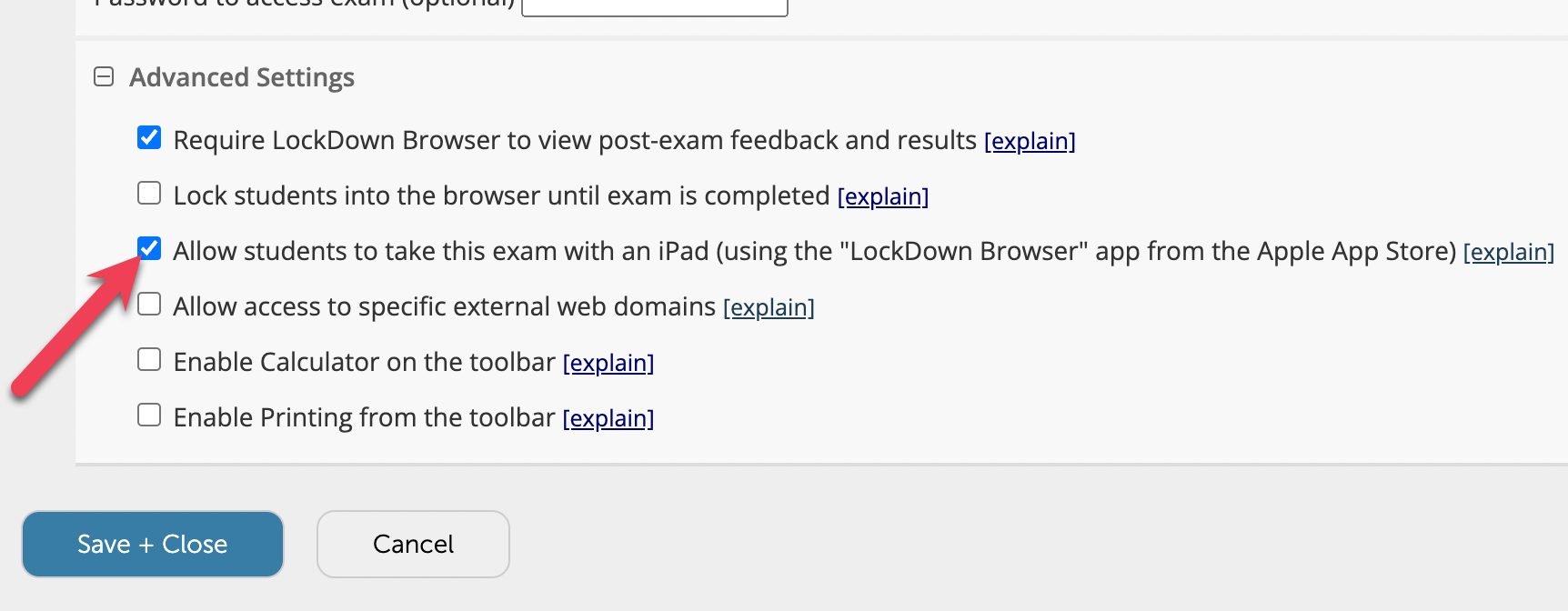
Select Advanced Settings.
Step 6
Select Allow students to take this exam with an iPad (and any other settings you want).
Step 7
Select the Save and Close button.
Quiz Time Limits
Some students, who have requested accommodations through the Disability Resource Center (DRC), require extra time to take a quiz.
Accessible Strategy
You can use Brightspace Accommodations feature in Classlist to extend quiz times for those students.
Note
Visit the DRC website (opens in new tab) and select Instructor Login to view any accommodations, including extra time on quizzes, that your students have requested., see if you have students who need extra time to take a quiz.
Matching Questions
With matching questions, students match items in one list with items in a second list. This formatting of two lists and the need to cognitively and visually track items that are left to match presents difficulties for learners using a mobile device and for learners who are blind or have low vision.
Note
Based on best practices of Universal Design for Learning (opens in new tab), it is best to avoid using matching questions. If you opt to use them, we suggest the following strategy to support all users:
Accessible Strategy
Consider using the Short Answer question type in tandem with the RegX Generator (opens in a new tab), which can help you create regular expressions, or algorithms that can be used to machine grade short answer, fill-in-the-blank, arithmetic, and significant figures questions. Contact the Instructional Technology team if you have questions on how to get started with the RegX Generator.
Disabling Right Click
The “Disable right click” setting can prevent learners who are blind or have low vision from taking a quiz.
Sometimes students must cut and paste text from a quiz into a program that converts text into speech. Disabling the right click prevents students from using the right mouse button, which opens a menu with options students need to copy quiz text.
The benefits of disabling right-click are limited and only apply in a proctored setting. It is ineffective in some Internet browsers; students can always take a picture of their screen using a separate phone or tablet.
Note
Based on best practices of Universal Design for Learning, it is best to avoid using the disable right-click setting. If you opt to use it, we suggest the following strategy to support all users:
Accessible Strategies
It is best to defer to the default Quiz settings and keep this setting turned off; however, if this setting is turned on, you can change this for select student’s by editing accommodations in the Classlist. While editing accommodations for a student, select to Always Allow Right Click, which will override the “disable right-click” setting in any Quiz in which it is enabled.
Accessibility Concerns about Restricting IP Addresses
Some students take quizzes in a testing center where they have access to assistive technologies and staff. Adding an IP Restriction that is specific to your classroom location will prevent students who use specialized testing centers from being able to access the quiz. This can also create problems for students taking a quiz off campus, from home, while traveling, etc.
Accessible Strategy
It is best not to set an IP Restriction. Consider, instead, other options such as time limits appropriate to the amount of content the quiz is assessing, shuffling questions, creating question pools so students receive different questions in their attempt, etc.
Note
The Disability Resource Center partners with instructors to create accessible classrooms, and can answer additional questions you have related to accessibility strategies in Quizzes. Visit the DRC website (opens in new tab) to learn more. Select Instructor Login on the DRC homepage to view any accommodations that your students have requested.
Add IP Restrictions (not advised)
An IP address is comprised of a series of numbers and periods. If you know the IP address for a room's router (what allows you to connect to the Internet using WiFi), you can narrow down where students can take the quiz.
Note
IP addresses on campus are not specific to one room or building, and some spaces may be served by more than one IP address. Thus, you cannot use IP addresses to require students to take the quiz from an exact location; they may be down the hall from your classroom or in a neighboring building and still able to connect to a router within the defined IP address range.
Step 1
Select Quizzes in the navbar.
Step 2
Select the quiz name.
Step 3
Select the Availability Dates & Conditions section.
Step 4
Select Manage IP Restrictions.
Step 5
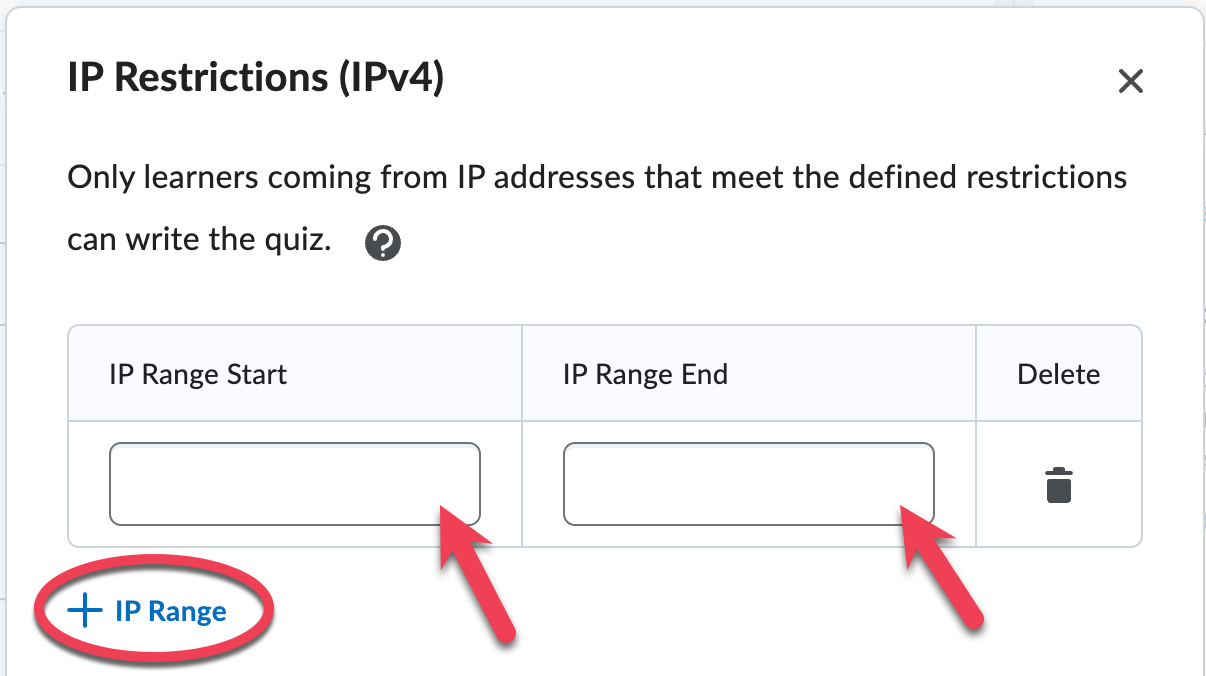
Enter the IP Range Start and End. Select the + IP Range button to add additional ranges.
Note
The first box must contain the 3 starting numbers of the IP address. Each additional field is optional depending on how specific you want the IP address restrictions to be
Step 6
Select the Add button.
Step 7
Select the Save button to remain in the quiz (or Save and Close to save your changes and exit the quiz).
View the IP Address Where a Student Took a Quiz
Note
If only the last several digits change, the student may have been in a single, large room that uses multiple routers. Because one space can be served by multiple IP addresses and because IP addresses are not specific to one room or building (they cover a much wider territory), it is not possible to know exactly where a student was when they took the quiz.
Step 1
Select Quizzes in the course navbar.
Step 2
Select the quiz's Actions Menu icon and select Grade.
Step 3
Select the Attempt # beneath a student's name to open their quiz attempt.
Step 4
Select Quizzes Event Log.
Step 5
Select the checkbox for Show IP Address.
