
Discussion on Work
On this Page
Overview
Discussion on Work creates a discussion space in which the conversation is centered around student submissions. Submissions can include documents, audio/video, images, links to websites, and screen sharing. Students are then paired into groups to discuss each other's work. Submissions can be made individually by each student or per group. Discussions can happen individually, within groups, outside of their group, or as a group.
A complete Discussion on Work will consist of the following default modules/steps, along with a list of configurable options at each step:
- Instructions - Written instructions for students to follow. Instructors can optionally attach video, audio, screen share, and files.
- Submissions - Students hand in their deliverable for the assignment.
- Peer discussion - Students discuss work from their peers before joining the open discussion learning step.
- Open discussion (optional) - Students can optionally contribute beyond the required discussion.
- Grading Module (optional) - Configure which facets of the activity should be weighed in the students grade and synced with the Brightspace Gradebook.
Instructors can also optionally add the following steps:
- Reflections - Students write a reflection on the outcomes of the activity and their learning. Supports automatic word counts, guidelines, and separate scheduling deadlines.
- Automated Feedback on Writing - Students receive AI-generated feedback on their writing submissions.
- Select Most Valuable Contributions - Let students select certain peers’ contributions that they found most valuable to increase autonomy and avoid free-riding.
Note
There are two discussion tools in FeedbackFruits: Discussion on Work and Discussion on Topic. This article describes Discussion on Work. For more information on the different Discussion types, visit the following help pages:
Setup Process
Step 1
Instructions
Here, you can write the instructions you want to provide to your students. If you'd like to include an audio, video, screen recording, or attach a file, select the add items icon to do so.

Collaboration Options
You can access the collaboration options in the initial creation of a Discussion on Work, or in the editor mode of a live activity. Collaboration options are always a sub-setting of the Instructions Step. To access the collaboration options menu, select the Student Collaboration dropdown, then select Change.

This will open the Collaboration options screen shown below.

This will allow for the following combinations:
-
Hand In individually, discuss individually
Use this option if you want students to individually post their discussion and then be assigned to engage with the posts of one or more random peers who have also shared their discussions.
-
Hand In individually, discuss within group.
Use this option if you want students to individually post their discussions and then participate in smaller group discussions to engage with their group member's posts.
-
Hand In individually, discuss outside of their groups
Use this option if you want students to individually post their discussions and then be assigned to engage with posts from peers outside their group.
-
Post discussions as a group, discuss individually
Use this option if you want students to collaborate on a single group discussion post but participate individually in discussions with posts from other groups.
-
Hand in work as a group, discuss individually the same work per group member
Use this option if you want the group to submit their work collectively, while each member individually reviews and discusses the same submission made by another group.
Step 2
Submissions
In the submissions section, instructors have the option to configure aspects of the submission step. The following can be configured in the Submissions step:
- Required number of files to hand in
- Scheduling Deadlines (deadlines automatically sync to the Brightspace Calendar tool)
- File type requirements
- Plagiarism Check (Powered by Turnitin)
- Guiding Students
- Intended for providing further instruction on the Submission step specifically.
Note
For more information on Scheduling Deadlines and Granting Extensions, please visit the Scheduling Deadlines and Granting Extensions help page.

Step 3
Peer Discussion
Configure the options for the Peer Discussions. Configuration options include:
- Required number of peer's work to discuss.
- Scheduling Deadlines (deadlines automatically sync to the Brightspace Calendar tool).
- Grading options - allow students to rate their peer's work using a 10-point scale.
- Guiding Students.
- Intended for providing further instruction on the Peer Discussion step specifically.

Step 4
Open Discussion (Optional)
The optional Open Discussion step allows students to view all the work and discussions of their peers in an all-class discussion. Configuration options include:
- Scheduling Deadlines (deadlines automatically sync to the Brightspace Calendar tool).
- Guiding Students.
- Intended for providing further instruction on the Open Discussion step specifically.
To remove the Open Discussion step, select the X icon in the top right of the Open Discussion step.

Step 5
Grading
In the Grading step, configure the various facets of the Discussion on Work steps to be graded and synced to the Brightspace Gradebook, as well as set publishing options and schedule automatic publishing dates/times.

To configure which facets and their respective percentages that are to be graded, select the CONFIGURE button in the bottom right.

In the Grading configuration screen, you can enable and disable the different facets of the assignment, or change the percentages associated with each step. Configure the options, then select the DONE button when you're satisfied with the settings.

Viewing Student Submissions and Discussions
There are several ways to view the various submissions and discussions in the activity. If you'd like to view only student submissions, select the file indicator icon in the Files handed in column of the Submissions step.

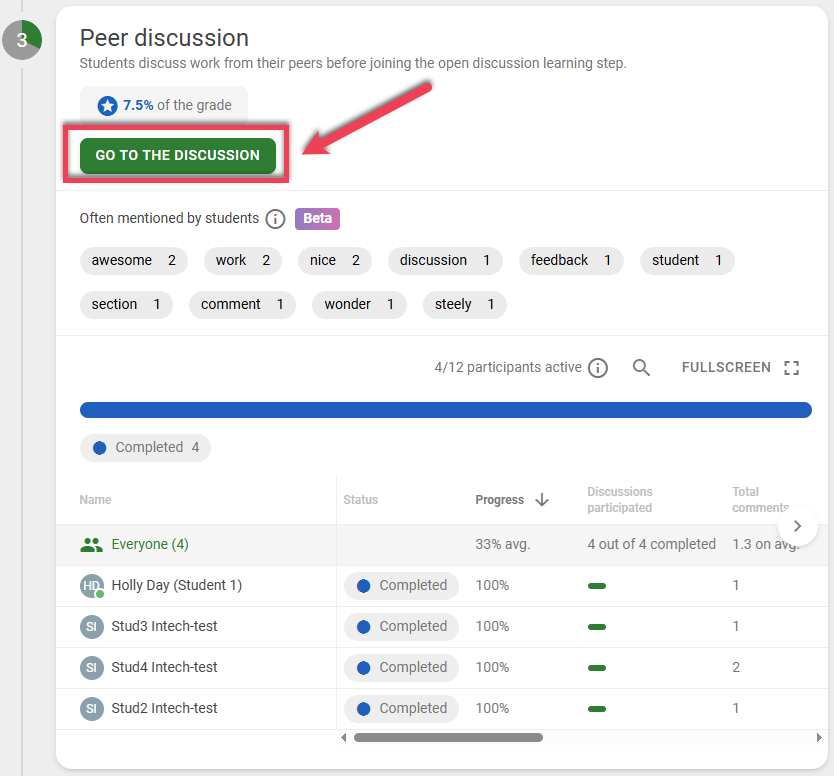
To review the discussion(s) along with the student submission(s), select to GO TO THE DISCUSSION button on either the Peer Discussion step or the Open Discussion step.
Optional Learning Steps
In addition to the default modules within each discussion, there are additional steps that can be added to enhance learning. These steps can be added my selecting the + symbol at the bottom of the module or going into edit mode, scrolling to the bottom. then selecting Add Additional Learning step.
Reflect on Activity - Students create a written reflection. Instructors can set scheduling deadlines and word counts.
Select most valuable contributions - Let students select certain peers’ contributions that they found most valuable to increase autonomy and avoid free-riding.
To add a learning step, select the ADD button. The learning step will be added and configured above the grading step.

Additional Resources
To further enhance your understanding on the functionalities of the Peer Review tool, please visit the FeedbackFruits website and their Discussion on Work (opens in a new tab) help pages.